In the Media

Archive

  1. The Case Against Rodrigo Duterte at the International Criminal Court

    Global Dispatches — World News That Matters - One year ago, in 2025, former Philippine President Rodrigo Duterte was extradited to The Hague to face charges of crimes against humanity and murder for orchestrating a campaign of extrajudicial killings against people he deemed to be involved in the drug trade. Over the course of several years while he was president, thousands of people were killed by police and hit squads. Now, he faces justice at the International Criminal Court. Nearly one year to the day after his extradition, Duterte faced his first major court proceeding: the confirmation of charges against him. This is a major moment for the Philippines and the International Criminal Court. Joining me to discuss the case against Rodrigo Duterte is Diane Desierto, Professor of Law at Notre Dame Law School and Professor of Global Affairs at the Keough School of Global Affairs at Notre Dame. We begin by discussing the specific charges against Duterte before having a broader conversation about the significance of this case for both the Philippines and the future of the ICC.

    Mentions

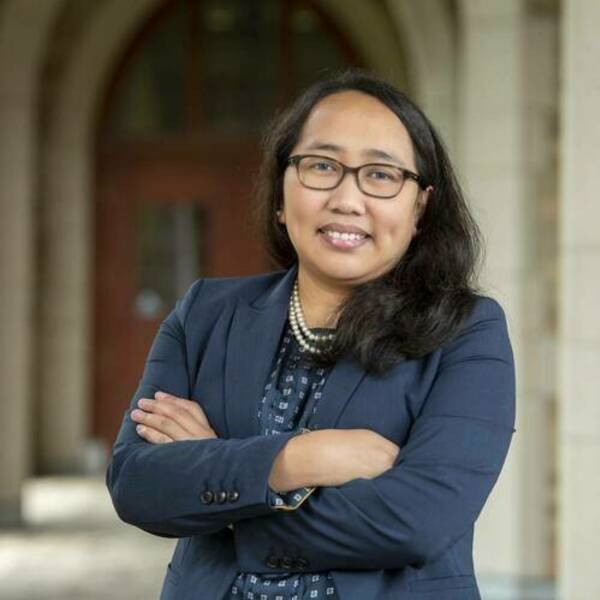
    Diane Desierto, a woman with glasses, wearing a navy blazer and pearl necklace, smiles with her arms crossed in front of a Notre Dame building's arched entryway.

    Diane Desierto

    Dean's Office-Law School

  2. Having Coffee With . . . Diane Desierto: Using the law to pursue civil rights goals

    Diane Desierto spends a lot of time thinking about dictators and autocratic regimes. Her life’s work focuses on fighting the global spread of authoritarianism.

    “The thing we should be concerned about is how ‘human rights’ has been co-opted by the dictators and the authoritarians and distorted,” says Desierto, a professor of law and global affairs, faculty director of the Notre Dame Law School’s master’s degree program in international human rights law and director of its new Global Human Rights Clinic.

    Mentions

    Diane Desierto, a woman with glasses, wearing a navy blazer and pearl necklace, smiles with her arms crossed in front of a Notre Dame building's arched entryway.

    Diane Desierto

    Dean's Office-Law School

  3. Expert from Notre Dame explains ongoing crisis in Haiti

    SOUTH BEND, Ind. (WNDU) - As violence continues to escalate in Haiti, the U.S. is planning to send more Marines to beef up security at the embassy there.

    But even with that, Americans are trapped in the increasingly chaotic country.

    Many of you may be confused about what’s happening there and why, so we brought Jean Marc Brissau to The WNDU Studios on Thursday to give us some perspective.

    He’s a graduate programs manager at Notre Dame Law School and is Haitian.

    Mentions

  4. The situation of Venezuela before the International Criminal Court: Advances and challenges of the first investigation in the Americas

    The Venezuelan investigation continues to advance at the International Criminal Court. This is the first investigation in the Americas before the Court and the first in history to be referred by the States Parties to the Rome Statute. Although the investigation at the ICC and those of the UN Independent Fact-Finding Mission have recently played a deterrent role in Venezuela that may have had an impact on the possible reduction of crimes committed by the State, this has not meant the real dismantling of the repressive structures in the country, since human rights violations continue to occur.

    Mentions

    Faisal Yamil Meneses

    Faisal Yamil Meneses

    Notre Dame Law School Global Human Rights Clinic

  5. Which Is More Dangerous: Outer Space or the Deep Sea?

    You, your crew and your craft float in hostile environs miles away from civilization. As you set about your mission, only a few inches of metal separate you from an environment that could kill you in moments. Your life depends on the engineers who designed your vessel. All it takes is one crack or puncture to rupture your shell and extinguish your life. These conditions apply equally to a submersible in the deep sea and a spacecraft beyond Earth. Given the similar risk of sudden death, it’s natural to ask: Which is safer?

    Recent news shows the question is more relevant than ever. In June 2023 a submersible craft called the Titan operated byOceanGate Expeditions was crushed while descending to the wreck of the Titanic on the seafloor of the Atlantic Ocean, killing all five men inside. The incident occurred only two months after SpaceX’s Starship, the largest rocket built to date, exploded less than four minutes after surging toward space in its first test flight—luckily, no one was onboard.

    Whether you’re going 20,000 leagues under the sea or from the Earth to the moon, spacecraft and submersibles follow many of the same engineering principles. Their passenger compartments are pressure vessels: containers designed, like an overachiever raised by demanding parents, to withstand high pressures inside and out.

    Mentions

    Diane Desierto, a woman with glasses, wearing a navy blazer and pearl necklace, smiles with her arms crossed in front of a Notre Dame building's arched entryway.

    Diane Desierto

    Dean's Office-Law School

  6. Faisal Yamil “In Venezuela there is a great structural, systemic and endemic problem that needs attention”

    Faisal Yamil is a young lawyer graduated from the Andrés Bello Catholic University, with a master's degree in International Human Rights Law from the University of Notre Dame (USA) and specialization in Human Rights and Business from the University of Lucerne (Switzerland) who Through his work at a legal office in Caracas, he began his experience in the field of litigation before the Universal United Nations System and the Inter-American System, which in turn connected him with Venezuelan civil society organizations. Currently, he carries out advocacy work for the Center for Justice and Peace (Cepaz) before international organizations, while he is an associate researcher in a laboratory for the design and compliance of reparations in cases of human rights violations at the Kellogg Institute for International Studies of the University of Notre Dame.

    Mentions

    Faisal Yamil Meneses

    Faisal Yamil Meneses

    Notre Dame Law School Global Human Rights Clinic

  7. Venezuela: Without implementation of recommendations, there is no justice

    Venezuelan civil society collective Justicia y Verdad today launched their new report, ‘Without the implementation of recommendations there can be no justice’, an analysis of the roadmap for reform provided by UN recommendations on the judicial system, the failures of the State to take action and the impact of that inaction on the fight of victims for justice.

    Mentions

    Faisal Yamil Meneses

    Faisal Yamil Meneses

    Notre Dame Law School Global Human Rights Clinic

  8. Independence of the judiciary, an end to arbitrary arrests and respect for civic space were the demands of civil society at HRC53

    “In Venezuela, the justice system lacks independence and impartiality” This is how Faisal Yamil, spokesperson for the International Service of Human Rights , began his participation by participating in the interactive dialogue for the presentation of the Report of the High Commissioner for Human Rights on Venezuela.

    Mentions

    Faisal Yamil Meneses

    Faisal Yamil Meneses

    Notre Dame Law School Global Human Rights Clinic

  9. Putin Wanted by ICC Over Alleged War Crimes

    The International Criminal Court (ICC) issued arrest warrants for Russian President Vladimir Putin and the country’s children’s rights commissioner, Maria Lvova-Belova, over allegations that Ukrainian children have been deported from occupied territories to Russia, which could constitute a potential war crime.


    Mentions

    Diane Desierto, a woman with glasses, wearing a navy blazer and pearl necklace, smiles with her arms crossed in front of a Notre Dame building's arched entryway.

    Diane Desierto

    Dean's Office-Law School

  10. Why the Philippines Is Letting the U.S. Expand Its Military Footprint in the Country Again

    It’s been more than 30 years since Philippine lawmakers moved to end the permanent U.S. military presence in the country. Previously, the U.S. operated two major bases, but many Filipinos saw the bases as a legacy of U.S. colonialism, and wanted to assert their independence.

    Now, the Philippines is inviting the U.S. to increase its military footprint in the country again—giving access to four new military bases amid rising tensions with China, the two countries announced Thursday.


    Mentions

    Diane Desierto, a woman with glasses, wearing a navy blazer and pearl necklace, smiles with her arms crossed in front of a Notre Dame building's arched entryway.

    Diane Desierto

    Dean's Office-Law School